The week the business argued about how to count
What is a subscriber, a fan, a hit, a human? Songwriters, scalpers, streaming services and a badge on YouTube all gave different answers this week, and the answers are worth billions.
Headlines
The short versionThe streaming services filed what they want to pay songwriters from 2028 to 2032. Spotify, Apple, Google and Pandora want to freeze the current deal at a 15.35% headline rate. Amazon wants to cut it to 13.4%. The publishers want 20% of revenue, $2.40 a subscriber, or $0.004 a play, whichever is greatest. The hearing is in March 2027. MBW
Catalogue now takes 45% of streams on Spotify's global Top 200, up from under 30% in each of the last two years, says Tim Ingham's analysis for MBW. Songs more than a decade old are three times the share they were in 2024. Miley Cyrus's new album fell 156 places in its second week, the steepest drop a No. 1 debut has ever had. MBW
Universal and Sony want DistroKid's AI numbers. A new filing on Friday asks the court to force the distributor to reveal how many AI-generated songs it pushes to streaming services, and claims it delivered nearly 12 million tracks to one service between March and September, more than every other distributor combined. The majors call it a "primary conduit". Digital Music News
Five years of songwriter pay, decided by what a subscriber is
Proposed US mechanical headline rates for 2028 to 2032, as a share of service revenue. Source: filings reported by MBW.
The proposals for Phonorecords V landed this week and they are not close, says MBW. Spotify and Apple argue the current terms should simply carry over. Google agrees, with a rule that rates only apply to plays the licence actually covers. Amazon alone wants a cut: 13.4% of revenue instead of 15.35%, a per-subscriber figure of 96 cents instead of $1.10, and a mechanical floor of 52 cents instead of 60. Its economist puts the reduction at about 13%.
The publishers and songwriters, through the NMPA and NSAI, are asking for the greatest of 20% of revenue, 40% of what labels get, $2.40 a subscriber, or four tenths of a cent a play, with the last two rising with inflation. The quiet part is in the definitions: they want family and student discounts gone, every sub-account on a family plan counted as a subscriber, and free trials no longer paid at zero. David Israelite's line is that songwriters should get at least 40% of what the recording side gets. Greg Prata of Sony Music Publishing argues the current percentage-of-revenue model lets services shave around 40% off mechanicals through its backstop, which rather defeats the point of a backstop.
The hearing runs from 22 March to 15 April 2027, with a decision due by 17 December, unless they settle first. They usually settle first.
For context, this is the same week Goldman Sachs raised its long-term music forecast for the first time since 2022. Its tenth Music in the Air sees the whole business at $198.1bn by 2035, up from $112.5bn, with streaming prices now expected to rise every one to two years and paid subscribers reaching 1.5 billion, says Bruce Houghton in Hypebot. Digital Music News read the same report and noted the growth won't necessarily reach the labels, which face a slow squeeze on share. The pie is growing. So is the queue of people with a fork, and the songwriters are at the back of it.
Eighteen months, $8,091,843.64, and 427 works
The streaming fraudster. Michael Smith of Cornelius, North Carolina, ran thousands of bot accounts that played hundreds of thousands of AI-generated songs, billions of times, between 2017 and 2024, and spread the plays thinly so no single song looked odd. On 6 October a Manhattan judge gave him eighteen months and ordered him to repay $8,091,843.64, to the cent. Prosecutors had asked for at least 46 months, says AI Weekly; his lawyers wanted probation. The IFPI told Music Week that enforcement is "only one part" of it. The next one will involve fewer emails.
Warner v Ray-Ban. Warner Music has sued Luxottica, owner of Ray-Ban and Oakley, over at least 427 recordings and songs it says were used in the brands' social videos without a licence, Miley Cyrus, Led Zeppelin, Dua Lipa and Fleetwood Mac among them. Warner hasn't named a figure; MBW did the sum at the statutory maximum and got $64m. Luxottica hasn't commented.
Live Nation v the FTC. In its answer to the regulator's BOTS Act case, Live Nation says the agency is trying to "flip the Act on its head" by using a law written against scalpers to go after the company that builds the defences. It cites $1bn spent on anti-bot measures since 2010 and 260 million bot attempts blocked a day. The FTC's case, reports MBW, is that Ticketmaster let brokers exceed limits with thousands of accounts, then took a fee when they resold. Judge Frimpong declined to dismiss it last month. The same week, SeatGeek and Vivid Seats sued Washington DC to block its 10% cap on resale mark-ups. And in London, Raye's team read 1.8 million presale sign-ups by hand to find the 5,000 real fans. Everyone, it turns out, is counting bots.
Three services, three answers to "is this a robot?"
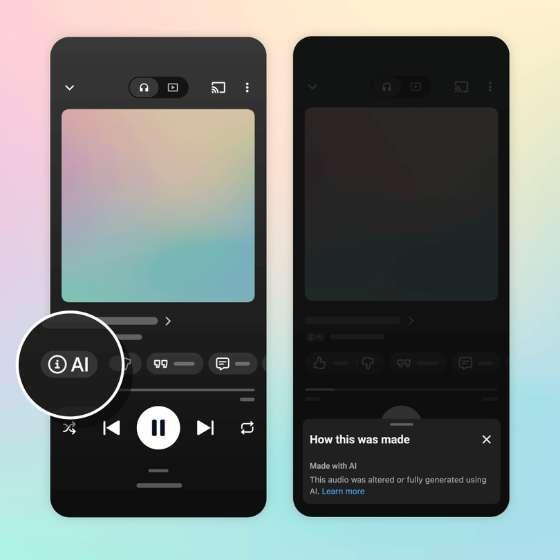
From 14 October YouTube Music puts a badge on tracks where a model did most of the work, built from partner declarations and its own detection, with the main app to follow (YouTube). Deezer goes further: its detector, which TIME just named an invention of the year, has kept 42 million AI tracks out of recommendations since January, and a global off switch for fully AI-made music arrives before the end of the year. Spotify labels the artist rather than the audio and leans on what distributors declare. So the same song can wear a different label on each service, as The AI Musicpreneur points out, and YouTube hasn't said whether its badge changes what gets recommended, which is the question that matters.
Upstream, the distributors are where the pressure now lands. MTUK reports DistroKid has started taking tracks down after Universal's September suit over AI copies and sped-up remixes; the new UMG and Sony filing (third headline, above) wants its upload numbers in court. Suno, meanwhile, hired Ticketmaster's former business-development chief Michael Chua to run a live-events division built on Songkick, which tells you what it thinks of the badge.
And then there is Korea. A rock ballad whose title translates roughly as Did you become the adult you dreamed of? reached No. 3 on Melon and No. 2 on Genie and YouTube Music, says Xportsnews. The voice is Suno's. It came out in June and climbed by word of mouth; a good many of the people who shared it found out later. The comments are split between those moved by the lyric and those unsettled by the singer. Which rather proves the Dayton point: they liked it. They just didn't want to be seen to.
Also this week
- Universal is cutting jobs again. Another round under the programme launched in February 2024 to save €250m a year; it finishes next year. MBW
- AEG bought Auguri Productions, the Paris company behind Stromae, Angèle and David Guetta's shows, as the "next step" in France. DMN
- Warner Chappell signed My Chemical Romance to a worldwide publishing deal. MBW
- The American Music Tourism Act is law. Signed on Tuesday, it tells the Commerce Department to promote travel to US music sites and events. MBW
- Ben Katovsky is CEO of Pipeline, Matt Spetzler's $200m financing platform for music and the creative industries. MBW
- Spotify is selling its own plumbing. A new B2B site, Spotify Technology, offers its recommendation engine and podcast studio to other platforms. MTUK
- Shakira's Madrid run passed $500m in tour revenue across 13 sold-out shows. DMN
- BMG wants to be the fourth major. Its target after the Concord merger is $2.5bn a year. MTUK
- Fri 23 Oct
- Raye, This Symphony May Contain Hope, Royal Albert Hall
- Before year end
- Deezer's off switch for fully AI-generated music goes live
- 22 Mar 2027
- Phonorecords V hearing opens in Washington; decision due by 17 Dec
The Dayton study on why people like AI music in private and disown it in public. Short, and it will change how you read every AI headline this month. University of Dayton
And for light relief, CelebrityAccess's satire about festivals banning AI music, a policy that lasted forty minutes before someone asked whether a laptop counts as an instrument. It is fiction. It is also the week.
Raye, 13 October“I have never witnessed bots on this scale.”
That's the week. If it was useful, pass it on to someone who'd find it useful too. If something's wrong or missing, hit reply; I read every one.
Until next Monday,
AJ
Written in Ramsbury, Wiltshire. Drawn this week from Music Business Worldwide, Digital Music News, Music Ally, Music Week, Hypebot, IQ, MTUK, The Rundown, YouTube, Deezer and others; every story links to its source. Subscribe · RSS
Every big story this week was an argument about counting. The streaming services told the US rate court what they think a songwriter should be paid per subscriber for the next five years; the publishers replied that a family plan with six accounts is six subscribers, not one. Raye's team counted 1.8 million sign-ups for 5,000 seats and found most of them weren't people. A judge in New York counted $8,091,843.64 of royalties that went to a man who had streamed his own robot songs. And YouTube started counting which songs were made by machines, and putting a badge on them.
Here's the thing Goodhart worked out decades ago and every industry relearns: the moment a number becomes money, it stops being a measurement and becomes a target. Pay per stream and you get bots. Pay per subscriber and the argument moves to what a subscriber is. Label the machines and the interesting fight is no longer whether the song is good but whether the badge is fair. (A study out of Dayton this summer found 88% of people say they prefer human-made music, right up until they press play, when the preference lasts about a minute.)
What strikes me, and I'll declare the bias, I'm building in this corner, is that every one of these counts is being done after the fact, by people who weren't in the room when the thing was made. Detection, forensics, subpoenas, hand-sorted guest lists. It is all very expensive bookkeeping for a business that never kept the books at the start.
Anyway. A good week for Michael Jackson, of all people.